Testing Quickstart
9 minute read
A practical guide to building a fast, reliable test suite that gives confidence without slowing down delivery. Focus on deterministic tests that run in CI and provide rapid feedback.
The Goal
Build a test suite that:
- ✅ Runs in under 10 minutes
- ✅ Is deterministic (same result every time)
- ✅ Catches real bugs before production
- ✅ Provides fast feedback to developers
- ✅ Doesn’t require heroic maintenance
Before You Begin
The Anti-Pattern to Avoid
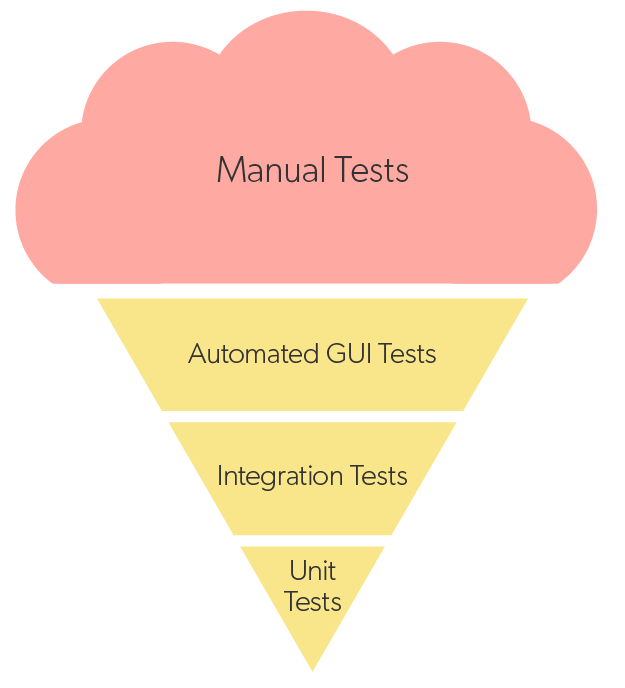
Ice Cream Cone Anti-Pattern
Ice Cream Cone Testing = Lots of slow, fragile E2E tests, minimal fast unit/integration tests
Why this fails:
- E2E tests are slow (minutes per test)
- E2E tests are non-deterministic (flaky)
- Debugging E2E failures is time-consuming
- Developers stop trusting the tests
The Right Pattern
Most tests should be integration tests - fast, deterministic, testing real interactions without external dependencies.
See Test Patterns for the full testing matrix.
Week 1 Action Plan
Day 1: Audit Your Current Tests
Action: Categorize and time your existing tests
# Run your test suite and capture metrics
npm test -- --verbose --timing

# or
mvn test -DreportFormat=plain
Create a test inventory:
Test Inventory

Unit Tests:
  Count: _____
  Time: _____ seconds
  Failures (last week): _____

Integration Tests:
  Count: _____
  Time: _____ seconds
  Failures (last week): _____

E2E Tests:
  Count: _____
  Time: _____ minutes
  Failures (last week): _____

Total CI Time: _____ minutes
Flaky test rate: _____%
Red flags:
- 🚩 Total CI time > 10 minutes
- 🚩 Flaky test rate > 1%
- 🚩 More E2E tests than integration tests
- 🚩 Tests that require deployed environments
Day 2: Fix or Delete Flaky Tests
Action: Zero tolerance for non-deterministic tests
Flaky tests destroy confidence. They must be fixed immediately or deleted.
Identify flaky tests:
# Run tests 10 times, capture failures
for i in {1..10}; do
  npm test 2>&1 | tee test-run-$i.log
done

# Analyze failures
grep "FAIL" test-run-*.log | sort | uniq -c
Common causes of flakiness:
| Cause | Solution |
|---|---|
| Network calls to external services | Use test doubles |
| Database state from previous tests | Reset DB between tests or use transactions |
| Timing/race conditions | Use deterministic time, avoid sleep() |
| Shared mutable state | Isolate test data |
| Async operations without proper waiting | Use proper async test patterns |
Rule
If a test can’t be made deterministic in 1 hour, delete it. It’s better to have no test than a test you can’t trust.Day 3: Write Your First Integration Test
Integration tests are your highest-value tests. They test real component interactions without external dependencies.
Example: API Integration Test (Node.js)
// tests/integration/user-api.test.js
const request = require('supertest');
const app = require('../../src/app');
const { setupTestDB, teardownTestDB } = require('../helpers/db');

describe('User API', () => {
  beforeAll(async () => {
    await setupTestDB(); // In-memory or test DB
  });

  afterAll(async () => {
    await teardownTestDB();
  });

  describe('POST /api/users', () => {
    it('creates a new user with valid data', async () => {
      const response = await request(app)
        .post('/api/users')
        .send({
          username: 'testuser',
          email: 'test@example.com'
        })
        .expect(201);

      expect(response.body).toMatchObject({
        id: expect.any(Number),
        username: 'testuser',
        email: 'test@example.com'
      });

      // Verify in database
      const user = await User.findById(response.body.id);
      expect(user.username).toBe('testuser');
    });

    it('rejects invalid email addresses', async () => {
      await request(app)
        .post('/api/users')
        .send({
          username: 'testuser',
          email: 'not-an-email'
        })
        .expect(400);
    });

    it('prevents duplicate usernames', async () => {
      // Create first user
      await request(app)
        .post('/api/users')
        .send({ username: 'duplicate', email: 'first@example.com' })
        .expect(201);

      // Attempt duplicate
      await request(app)
        .post('/api/users')
        .send({ username: 'duplicate', email: 'second@example.com' })
        .expect(409); // Conflict
    });
  });
});
Key characteristics:
- ✅ Deterministic - Same input = same output
- ✅ Fast - Runs in milliseconds
- ✅ Isolated - Uses test database
- ✅ Complete - Tests happy path and errors
- ✅ Real - Uses actual components, not mocks
See Integration Testing for patterns in other languages.
Day 4: Implement Test Doubles for External Services
Action: Mock external dependencies
External services (APIs, payment gateways, email, etc.) make tests slow and non-deterministic.
Example: Testing with External API
// tests/integration/payment-service.test.js
const nock = require('nock'); // HTTP mocking library
const PaymentService = require('../../src/services/payment');

describe('PaymentService', () => {
  afterEach(() => {
    nock.cleanAll();
  });

  it('processes successful payment', async () => {
    // Mock the external payment API
    nock('https://api.payment-provider.com')
      .post('/charges')
      .reply(200, {
        id: 'ch_123',
        status: 'succeeded',
        amount: 1000
      });

    const service = new PaymentService();
    const result = await service.charge({
      amount: 1000,
      currency: 'usd',
      source: 'tok_visa'
    });

    expect(result.status).toBe('succeeded');
    expect(result.chargeId).toBe('ch_123');
  });

  it('handles payment API failures gracefully', async () => {
    // Mock API failure
    nock('https://api.payment-provider.com')
      .post('/charges')
      .reply(402, {
        error: 'insufficient_funds'
      });

    const service = new PaymentService();

    await expect(
      service.charge({ amount: 1000, source: 'tok_visa' })
    ).rejects.toThrow('Payment failed: insufficient_funds');
  });

  it('retries on network errors', async () => {
    // Mock network error then success
    nock('https://api.payment-provider.com')
      .post('/charges')
      .replyWithError('ECONNREFUSED')
      .post('/charges')
      .reply(200, { id: 'ch_123', status: 'succeeded' });

    const service = new PaymentService({ retries: 1 });
    const result = await service.charge({ amount: 1000, source: 'tok_visa' });

    expect(result.status).toBe('succeeded');
  });
});
Test Double Types:
- Stub - Returns canned responses (use for queries)
- Mock - Verifies interactions (use sparingly)
- Fake - Working implementation (e.g., in-memory database)
See Test Doubles for detailed patterns.
Day 5: Reduce E2E Test Count
Action: Convert E2E tests to integration tests
E2E tests should only cover:
- Critical user paths (login, checkout, etc.)
- Scenarios that absolutely require a browser
- Integration between major system components
Before: E2E Test (Slow, Flaky)
// Takes 30 seconds, requires browser + full stack
test('user can update profile', async () => {
  await page.goto('http://localhost:3000/login');
  await page.fill('[name=email]', 'user@example.com');
  await page.fill('[name=password]', 'password123');
  await page.click('button[type=submit]');
  await page.waitForNavigation();

  await page.goto('http://localhost:3000/profile');
  await page.fill('[name=displayName]', 'New Name');
  await page.click('button:has-text("Save")');
  await page.waitForSelector('.success-message');

  expect(await page.textContent('.display-name')).toBe('New Name');
});
After: Integration Test (Fast, Reliable)
// Takes 50ms, no browser needed
test('user can update profile', async () => {
  // Arrange: Create authenticated user
  const user = await createTestUser({ email: 'user@example.com' });
  const token = generateAuthToken(user.id);

  // Act: Update profile
  const response = await request(app)
    .put('/api/users/me')
    .set('Authorization', `Bearer ${token}`)
    .send({ displayName: 'New Name' })
    .expect(200);

  // Assert
  expect(response.body.displayName).toBe('New Name');

  // Verify in database
  const updatedUser = await User.findById(user.id);
  expect(updatedUser.displayName).toBe('New Name');
});
Savings:
- 🚀 30 seconds → 50ms (600x faster)
- ✅ Deterministic (no browser timing issues)
- 🔧 Easier to debug (no UI layer)
Week 1 Results
After 5 days, you should have:
✅ Test inventory completed ✅ Zero flaky tests (fixed or deleted) ✅ 5-10 new integration tests covering critical paths ✅ External dependencies mocked using test doubles ✅ E2E tests reduced to < 5 critical scenarios ✅ CI time reduced (target: < 10 minutes)
Test-Driven Development (TDD)
Once you have a solid test foundation, consider TDD:
The Red-Green-Refactor Cycle:
1. 🔴 Red: Write a failing test
   - Write the test first
   - Run it, watch it fail
   - Confirm the failure message makes sense

2. 🟢 Green: Make it pass
   - Write the minimal code to pass
   - Don't worry about perfection
   - Get to green quickly

3. ♻️ Refactor: Improve the code
   - Tests passing? Now improve the design
   - Extract methods, rename variables
   - Tests should still pass
Example TDD Flow:
// 1. RED: Write failing test
test('calculates discount for VIP customers', () => {
  const order = new Order({ customerId: 'vip-123', total: 100 });
  expect(order.finalPrice()).toBe(90); // 10% discount
}); // FAILS - method doesn't exist

// 2. GREEN: Minimum code to pass
class Order {
  finalPrice() {
    return this.total * 0.9; // Hardcoded, but passes!
  }
}

// 3. REFACTOR: Add more tests, improve design
test('no discount for regular customers', () => {
  const order = new Order({ customerId: 'reg-456', total: 100 });
  expect(order.finalPrice()).toBe(100);
}); // FAILS

// Refactor to handle both cases
class Order {
  finalPrice() {
    const customer = Customer.findById(this.customerId);
    const discount = customer.isVIP ? 0.1 : 0;
    return this.total * (1 - discount);
  }
}
See TDD Resources for learning materials.
Testing Matrix Reference
Use this matrix to determine where each test belongs:
| Test Type | Deterministic | Network | Database | Speed | % of Suite |
|---|---|---|---|---|---|
| Static | Yes | No | No | Instant | 100% |
| Unit | Yes | No | No | < 10ms | 20% |
| Integration | Yes | localhost | test DB | < 100ms | 70% |
| Contract | No* | Yes | - | < 1s | 5% |
| Functional | Yes | localhost | test DB | < 500ms | 4% |
| E2E | No | Yes | Yes | seconds | 1% |
*Contract tests run against live services but don’t break the build
Common Patterns by Language
JavaScript/TypeScript
- Framework: Jest, Vitest, or Mocha
- Integration: Supertest (HTTP), Testcontainers (DB)
- Mocking: Nock (HTTP), MSW (browser)
- E2E: Playwright, Cypress
Java
- Framework: JUnit 5, TestNG
- Integration: Spring Test, Testcontainers
- Mocking: Mockito, WireMock
- E2E: Selenium, RestAssured
Python
- Framework: pytest, unittest
- Integration: pytest-flask, pytest-django
- Mocking: pytest-mock, responses
- E2E: Selenium, Playwright
Go
- Framework: Built-in
testingpackage - Integration: httptest (stdlib), dockertest
- Mocking: gomock, testify/mock
- E2E: Selenium, chromedp
C# / .NET
- Framework: xUnit, NUnit, MSTest
- Integration: WebApplicationFactory, Testcontainers
- Mocking: Moq, NSubstitute
- E2E: Selenium, Playwright
Troubleshooting
“Our tests are still taking 15 minutes!”
Diagnose:
# Find slowest tests
npm test -- --verbose | grep "PASS\|FAIL" | sort -k4 -n -r | head -20
Common fixes:
- Run tests in parallel (
npm test -- --maxWorkers=4) - Use in-memory database instead of real DB
- Cache dependencies in CI
- Split test suite (fast tests in PR, full suite nightly)
“Tests pass locally but fail in CI”
Common causes:
- Timing differences (use deterministic time mocking)
- Environment differences (port conflicts, missing env vars)
- Test order dependency (tests should be independent)
- Race conditions (use proper async handling)
Fix:
// BAD: Timing-dependent
test('displays message after delay', async () => {
  showMessage();
  await new Promise(resolve => setTimeout(resolve, 1000));
  expect(getMessage()).toBe('Hello');
});

// GOOD: Wait for condition
test('displays message after delay', async () => {
  showMessage();
  await waitFor(() => expect(getMessage()).toBe('Hello'));
});
“Developers skip tests because they’re too slow”
Reality: If tests slow down development, they’ll be skipped or removed.
Solutions:
- Speed up tests (see above)
- Run subset locally (fast tests only)
- Parallel execution
- Watch mode (only run changed tests)
# Fast feedback loop
npm test -- --watch --changedSince=main
Best Practices Summary
✅ DO:
- Write integration tests for most scenarios
- Make tests deterministic
- Keep CI under 10 minutes
- Test behavior, not implementation
- Use descriptive test names
- Fail fast (exit on first error)
❌ DON’T:
- Keep flaky tests
- Test private methods directly
- Use sleep/wait for arbitrary time
- Share test data between tests
- Mock everything (over-mocking)
- Write tests after the code (try TDD!)
See Testing Best Practices for comprehensive guidance.
Next Steps
After establishing your test foundation:
- Adopt TDD - Write tests first for new features
- Add contract tests - Verify API compatibility (Contract Testing)
- Implement mutation testing - Verify test quality
- Add performance tests - Catch regressions early
- Enable test coverage tracking - But don’t obsess over 100%
Further Reading
- Test Patterns Overview - Test pyramid, trophy, and ice cream cone
- Static Testing - Linting, type checking
- Unit Testing - Testing in isolation
- Integration Testing - Testing component interactions
- Contract Testing - API compatibility testing
- E2E Testing - Full system testing
- Test Doubles - Mocks, stubs, and fakes